Brew Guides
All you need to make a great cup of coffee is quality ground coffee, hot water, time, and a little je ne sais quoi. This section is filled with the kind of tips and tricks that will make magic in the cup.
Here’s to you, fellow coffee wizard!











Frequently Brewed Questions
Different brewing methods highlight different characters locked away in a coffee bean. Although there can be a sometimes overwhelming variety of drippers, press pots, and other nifty mechanisms, essentially, there are two broad categories of coffee preparation: immersion and percolation.
Immersion methods extract coffee by steeping. Examples are French press, cold brew, cowboy coffee, and AeroPress (which actually incorporates percolation as well). These methods bring out a heavier body and a little more sweetness in the cup, but lack some of the clarity attainable in percolation methods. These cups stand up great to cream, and are a little less finicky if you have trouble focusing before you’ve had your coffee in the morning.
Percolation methods extract coffee by filtering water through a bed of coffee, usually housed by a drip device. Overall, they offer a lighter bodied cup with more nuance to the acidity, aroma, and sweetness. V60, Chemex and Kalita all have different thicknesses to the filter paper and encourage the water to flow through the coffee bed in different ways, which produces different emphases of character in your final cup. As our head roaster points out, “The finer the filter, the more clarity in the cup because finer filters will prevent more fines and oils from landing in your solution.”
If you can’t decide between immersion and percolation, AeroPress is your go-to. It offers a smooth, solid body while producing the clean cup loved by drip enthusiasts.
Now that you have good whole bean coffee, fresh, filtered water, and a brewing device, what other tools can help you brew a great and consistent cup?
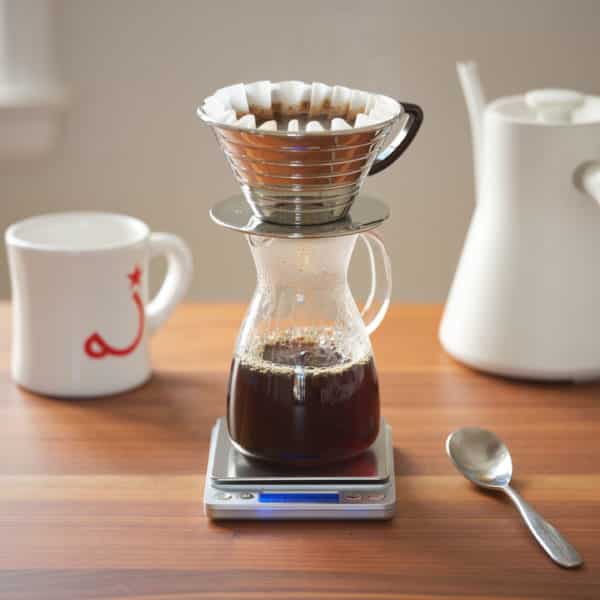
Our overwhelming consensus at Ritual is that a scale and timer are key. Just as in baking, the ability to identify, control, and repeat the precise weights and timing of your coffee, pours, and final brew time are essential to making adjustments to a recipe you didn’t like and repeating the recipes you love.
A good burr grinder is as equally important as a timer and scale in producing a balanced cup of coffee. While grinding coffee fresh and immediately before brewing is important to getting the most out of your coffee, a parallel blade grinder (as opposed to a burr grinder) creates a wide range of particle size in your ground coffee, which leads to some grounds lending a bitter, over-extracted flavor and others a sour, under-extracted flavor. A burr grinder (similar to a pepper mill) creates a much smaller difference between fines (tiny grounds) and boulders (not so tiny grounds).
If you aren’t ready to invest in a burr grinder and prefer to grind your coffee fresh rather than have it ground at the cafe with a commercial grinder, some tips for using a blade grinder are to shake it like a cocktail while grinding and grind finer than you may think you need to. We also suggest using a timer to keep track of both how long you grind and how to replicate favorable results. Pro Tip: immersion brew methods tend to handle blade-ground coffee a little better than drip methods.
Finally, a gooseneck kettle is incredibly helpful in fine-tuning your pours, which is especially important for percolation/drip methods. A thermometer can also be helpful in gauging proper water temperature.
First off, make sure all your wares are clean! If you don’t clean your tools consistently, coffee oils will build up and go rancid, affecting the final flavor in your cup.
Like many foodstuffs, coffee tastes best when fresh. Coffee will taste best between 3 and 21 days past the roast date if stored in its whole bean form until you’re ready to brew. If you choose to have your coffee pre-ground for you, it will stay fresh for significantly less time, especially in the aromatic and fruit forward aspects of the cup.
While 3–21 days is the window for the best cup of coffee, coffee can still taste good up to one or two months after roasting, especially under optimal storage conditions (in a dark, cool, airtight space). The higher humidity in freezers and refrigerators actually makes coffee go stale faster: humidity and water are coffee’s enemies—until it’s time to brew! If you’re cleaning out the cupboard, find an old bag of coffee, and don’t want to throw it away – it can still taste great as cold brew!
If you’re heating your water on the stove, bring it to a boil then let it sit for 20 seconds or so to cool down before pouring. Most coffees brew best between 200F and 205F, any hotter and you’ll scorch the beans. Always use fresh filtered water, and never use a microwave to heat your water. The way water heats in a microwave makes it go flat, and creates a less lively, vibrant cup.
Taking as many notes with as many solid numbers as possible (especially coffee and water weights and time) can help you fine tune your brewing process, recreate the cups you loved, and avoid the ones you loved not so much. The more consistent you are, the more consistent your brews will be.
If your coffee tastes more bitter than you would prefer, you’ve over extracted and pulled too much from the grounds. To correct this, you can coarsen your grind, increase the amount of coffee you use, shorten the brew time, or use cooler water.
If your coffee tastes more sour than you desire, you’ve under extracted. The opposite solutions to over extraction apply: fine the grind, decrease the amount of coffee, lengthen the brew time, or use hotter water.
If you have a balance of pleasant bitterness and tangy acidity in your cup but think you can pull out a little more sweetness, try slightly increasing your brew time or restricting the flow of water through your coffee bed with a finer grind.
Whenever you troubleshoot your brew, remember to take as many notes as possible, and only change one variable at a time. That way, it’s easier to backtrack and identify how each aspect in the brew process impacts your final cup.
